

It’s been mere days since former UK Labour PM Tony Blair, a globalization extraordinaire, and a (digital) ID cards enthusiast remarked that it might take “a little persuading” for his country’s new government to get with that particular program.
And it seems the new Labour government really only needed a little persuasion – after “rejecting” Blair’s call to implement digital ID cards on July 7, by July 10 there were statements by an influential party figure calling that path “inevitable.”
However, that figure – former Home Secretary David Blunkett – is not a member of the just-formed cabinet, and was with his statements challenging current Home Secretary Yvette Cooper, who opposed the idea.
But, Blunkett – who served in Blair’s government – said that “the government would have to streamline (growing digital records) into a single ID.”
Fast forward one week, and it seems Cooper’s cabinet colleague, Secretary of State for Science, Innovation and Technology Peter Kyle, is starting to reverse course.
Somewhere in the meanwhile, Business Secretary Jonathan Reynolds first said the government would be “looking at all sources of advice” – only to quickly backtrack and say there were no ID card plans.
All this leaves observers puzzled as to what the government’s actual stance on this important issue is.
Kyle spoke for ITV and attempted to separate the concept of ID cards and digital ID, which some observers rejected as little more than “playing a semantic game.”
Kyle said the new government was prioritizing “verification” (in terms of providing “one login” for access to digital services) over (digital) ID cards which he said “conjures up” (and rightly so, say opponents) images of a universal system that affects everyone on and off the internet.
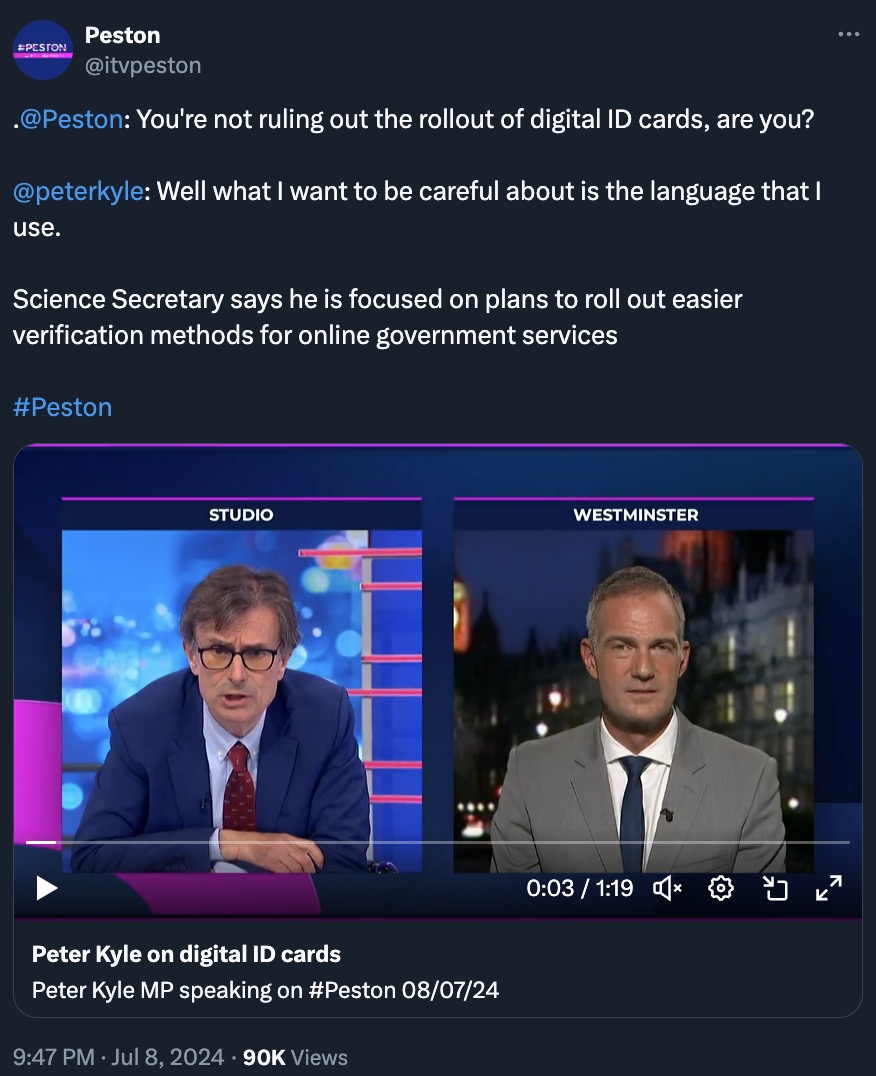
When asked if he was ruling out digital ID, Kyle said he wanted to be “careful about the language” he was using.
He certainly was, because nothing was really “ruled out;” the secretary went on to speak about expanding the verification system, “easier experience,” (the old convenience) – and, “see where digital verification needs to go in the future.”
It could be reasonably surmised that Tony Blair can be satisfied with the way things are developing. Back in the day, he tried to introduce ID cards in the UK, but his “mission” is now much more ambitious with the digital element.
This time, Blair is cynically framing the scheme as necessary to “control immigration;” but opponents are rejecting digital ID as a dangerous centralization of state power (and mass surveillance).
Bilderberg Expert Advises Trump: He Must Destroy The Intelligence Apparatus