

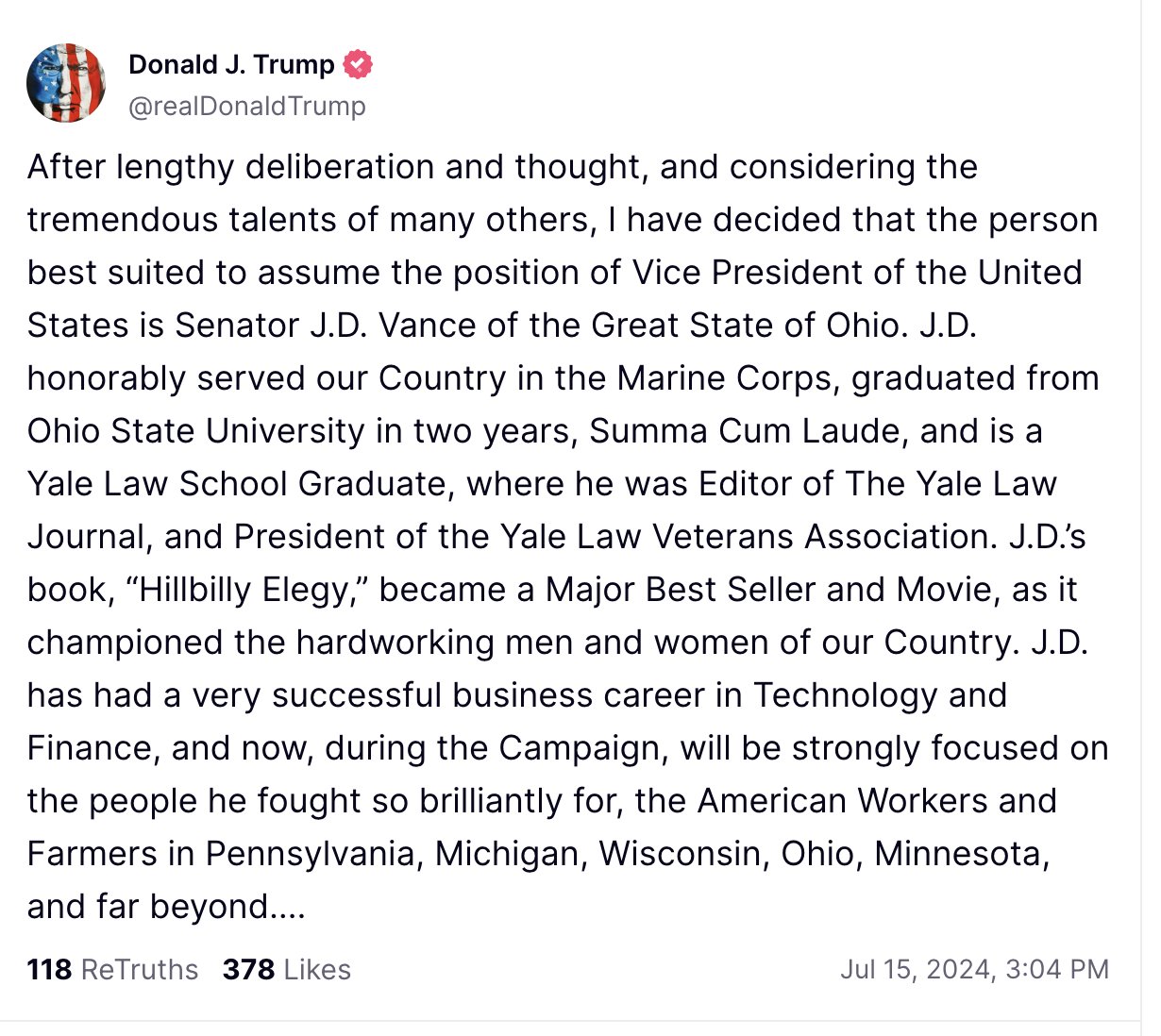
On Monday, Ohio Senator J.D. Vance was announced by President Donald Trump as his vice-presidential candidate for his 2024 campaign. This decision comes as Trump seeks to win back the presidency from President Joe Biden.
Vance, a figure that has seamlessly transitioned from the world of venture capitalism to the halls of US politics, brings a unique perspective to the ongoing debates surrounding technology and antitrust legislation. As a former venture capitalist and current Ohio Senator, Vance’s views are poised to significantly influence policy making in an era where tech giants face increasing scrutiny under antitrust laws.
This significant leap in Vance’s career could trace its origins to the early support of Peter Thiel, a major figure in Silicon Valley known for co-founding PayPal and the defense contractor Palantir, and for his connections with Elon Musk.
Following a brief tenure at a corporate law firm, Vance relocated to San Francisco to join Mithril Capital, a tech fund owned by Thiel, all while penning his memoir, “Hillbilly Elegy.” His venture into the financial world of technology deepened when he launched his own venture capital firm in Ohio, supported heavily by Thiel. It wasn’t long before political ambitions surfaced, with Thiel’s encouragement spurring Vance’s senate candidacy by 2021.
Trump’s selection of Vance was announced via Truth Social, where he commended Vance for his notable career in technology and finance.
With Vance’s rise to prominence, particularly following his endorsement as former President Trump’s running mate, understanding his approach to these tech issues is more important than ever.
Vance’s admiration for Federal Trade Commission Chair Lina Khan’s expansive view of US antitrust law was evident, suggesting potential policy directions in a new Trump administration.
Vance’s support of Khan highlights a split within the conservative movement, balancing a desire to reduce regulation with utilizing antitrust laws to address dominance, particularly in the tech sector. He believes these laws should not only focus on consumer prices but also on a broader competitive landscape. This perspective aligns him with other Republicans such as Senator Josh Hawley and Representative Matt Gaetz, who share this broader interpretation of antitrust objectives when it comes to the power of Big Tech.
At a Washington event in February, Vance articulated this stance on Khan: “She recognized there has to be a broader understanding of how we think about competition in the marketplace.”
Vance also said: “The fundamental question to me is, how do we build a competitive marketplace that is pro-innovation, pro-competition, that allows consumers to have the right choices and isn’t just so obsessed on pricing power within the market that it sort of ignores all the other things that really matter?”
His position indicates a readiness to challenge major tech companies, which is consistent with the antitrust actions seen during Trump’s first term. Under Trump’s presidency, the FTC and Department of Justice pursued antitrust investigations against major firms like Meta, Amazon, Apple, and Google, all of which faced lawsuits over alleged antitrust violations.
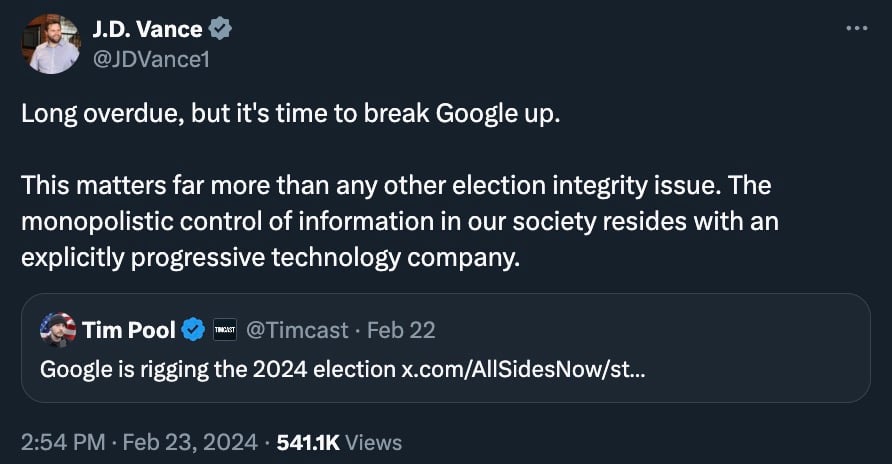
Vance has been vocal about his views on Big Tech, advocating for significant actions such as breaking up Google, as evidenced by his tweet in February criticizing the company’s monopolistic control over information.
“Long overdue, but it’s time to break Google up,” Vance posted, lamenting that “monopolistic control of information in our society resides with an explicitly progressive technology company.”
“I think that Google and Facebook have really distorted our political process, and I think that a lot of my friends on the left would agree with me, but they might disagree with me directionally about how to fix that problem,” Vance said.
Vance criticized the Biden administration’s collaboration with Big Tech to censor Americans, arguing that this partnership stifled necessary debates, particularly regarding the impact of school closures on children’s mental health and socialization.
During a Senate Republican press conference, Vance highlighted the human costs of such censorship, noting increases in depression among children who were unable to attend school and interact with peers. He emphasized the broader implications for democracy, questioning whether the real threat comes from the electorate’s potential voting preferences or from tech companies with ties to foreign interests collaborating with government agencies like the FBI to limit free speech. Vance asserted the importance of preserving public discourse on social media, which he described as the modern “town square” where critical national debates occur.
Senator Vance expressed concerns about a proposed Irish legislation, the Criminal Justice (Incitement to Violence or Hatred and Hate Offences) Bill 2022, in a letter to Irish Ambassador Geraldine Byrne Nason. Noting its impact on US tech companies, Vance criticized the bill for its vague prohibitions which he fears could suppress vital public debates, especially on sensitive issues. He highlighted that the legislation includes penalties for actions in public that could incite hatred, with potential impacts on discussions around immigration and gender definitions. Vance warned that the fear of prosecution under such ambiguous laws might lead citizens to self-censor, thereby undermining the rich tradition of free speech in Ireland and elsewhere.
Senator Vance has expressed skepticism for strong regulations against AI technology, arguing that such legislation would give more power to Big Tech incumbents.
“…Very often CEOs, especially of larger technology companies that I think already have advantageous positions in AI, will come and talk about the terrible safety dangers of this new technology and how Congress needs to jump up and regulate as quickly as possible. And I can’t help but worry that if we do something under duress from the current incumbents, it’s going to be to the advantage of those incumbents and not to the advantage of the American consumer,” Vance said during a Senate hearing last week.
President Trump’s vice-presidential pick brings a crucial focus on US tech policy and antitrust issues. Vance’s blend of conservative values and progressive views on corporate dominance and free speech positions him uniquely within the Republican party but it’s yet to be seen how his influence on Trump’s campaign and policy direction, especially regarding technology and censorship, will be important in their bid to reclaim the White House.