

Yemen’s Iran-linked Houthis have already been deploying both aerial and sea drones (or boat/surface drones) against international vessels and warships in the Red Sea, alongside ballistic missiles. The last several days have seen direct hits on commercial tankers, as we’ve detailed.
But there are new reports the Houthis have yet another ‘toy’ in their arsenal, with help from Iran, and it has been used in attacks this past weekend: an unmanned submarine. “The U.S. conducted what it called self-defense strikes on five targets in the Houthi-controlled area of Yemen after the Houthis employed an unmanned submarine for the first time since attacks in the Red Sea and Gulf of Aden began, the Pentagon said,” according to ABC, detailing events which happened Sunday.
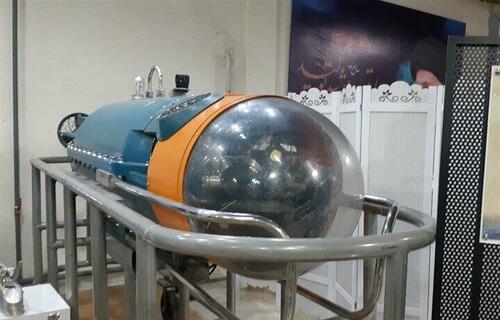 Underwater drone, via Iran’s Mehr News Agency
So far, the US-led coalition has had to defend primarily against surface boat drones, which are easier to spot, but now the Houthis have something harder to detect in their ongoing war on Red Sea shipping in response to Israel’s war in Gaza.
ABC News national security and defense analyst Mick Mulroy, who formerly worked at the CIA and the Pentagon, has described that the Houthis are escalating their efforts to strike a US warship.
“The Houthis and the IRGC [Islamic Revolutionary Guard Corps] are adjusting their strategy, apparently because they haven’t been successful in striking a U.S. naval vessel,” Mulroy said. “If one or more of these weapons get through and kill U.S. sailors, Iran should expect to be held directly responsible.”
“The Houthis are not likely capable of manufacturing these weapons on their own, so they are probably coming from Iran,” he explained, and went on to describe the Houthi strategy as seeking to “overwhelm the ship’s defenses” in a “swarm attack.”
Thus it appears the Houthis are now capable of mounting more sophisticated, multi-dimensional attacks by air, water’s surface, and from under the water.
It was only in December of last year that Iranian state media unveiled the domestic development of the country’s first underwater drone (UUV):
The homegrown UUV, also known as an underwater drone that can operate without a human occupant, was unveiled in an exhibition of the Iranian Navy’s achievements on Saturday.
The underwater vehicle can discover and terminate various underwater mines by carrying a wide range of equipment. The Iranian UUV can go as deep as 200 meters with an endurance of 24 hours.
Since the Persian Gulf is relatively shallow, it may contain a series of underwater mines laid at depths of 10 to 50 meters, which could cause serious damage to vessels as heavy as 250 tons.
#BREAKING HOUTHIS HAVE SUBMARINE DRONES
US CENTCOM: “The Houthis used a drone submarine for the first time since the start of their attacks.”
Source: AlArabiya#Yemen #Redsea #Gaza #GazaGeniocide #Houthi #HouthiDrone #UAV pic.twitter.com/h13ClO6eXL
— Dailyfusenews (@dailyfusenews) February 18, 2024
Recent reports from the region say that Iran’s navy has at least one spy ship operating in the Red Sea area. Previously US officials said the spy ship is likely assisting the Houthis with targeting information.
If these fresh reports that Tehran is supplying the Houthis with underwater drones are true, there’s a likelihood that the drones could be assisted from Iranian reconnaissance assets in the region.
EXCLUSIVE: New Form Of Blood Clots Found In 50% Of The Dead, Coroner Survey Reveals